

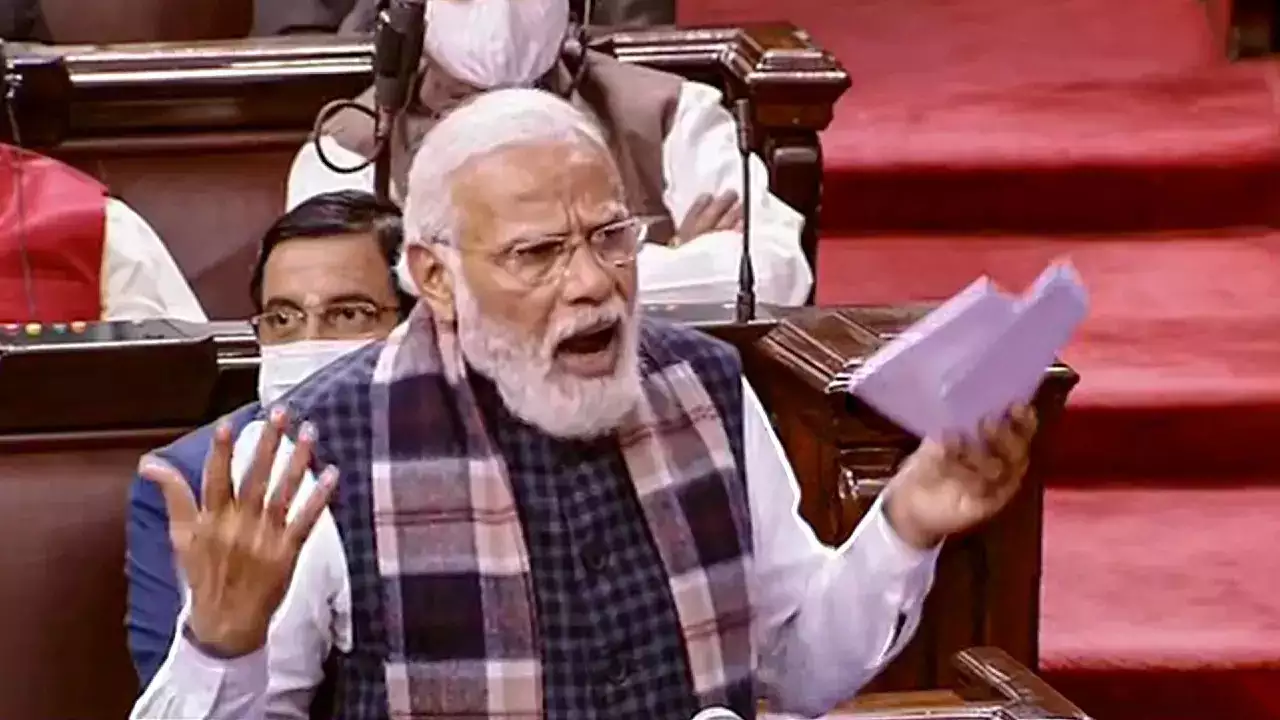

Prime Minister Narendra Modi, on Saturday, criticized the Congress party for repeatedly undermining the Constitution, accusing the Nehru-Gandhi family — spanning Jawaharlal Nehru, Indira Gandhi, Rajiv Gandhi, and Rahul Gandhi — of committing “sins” against its principles.
During his address in the Lok Sabha, marking a debate on the “Glorious Journey of 75 Years of the Constitution of India,” Modi countered Congress’s support for a caste census and removal of the 50% reservation cap, claiming the party had historically opposed reservations. He accused the Congress of pushing for religion-based quotas, which he said violated the spirit of the Constitution, motivated by their “greed for power” and vote bank politics.
Modi reiterated his government’s commitment to a Uniform Civil Code (UCC), describing it as a “secular civil code” aligned with constitutional values. Highlighting that the Constituent Assembly supported a UCC, Modi said his government was working with full determination to implement it, emphasizing that personal laws based on religion must be replaced to uphold equality.
Modi contrasted his government’s adherence to constitutional principles with the Congress’s alleged history of undermining them. He claimed that his administration’s policies since 2014 — including GST, abrogation of Article 370, and the “one nation, one health card” initiative — were rooted in strengthening national unity and respecting the Constitution.
Targeting the Congress’s record on reservations, Modi alleged that Nehru, Indira, and Rajiv Gandhi had consistently opposed it. He noted that the Mandal Commission report, which expanded OBC reservations, was only implemented after Congress was ousted from power. Modi argued that Congress’s opposition to reservations deprived marginalized communities of opportunities for decades.
In a sharp critique of the Nehru-Gandhi family, Modi cited instances where they allegedly undermined the Constitution, including Nehru’s 1951 amendment that curbed freedom of speech, Indira Gandhi’s 1975 Emergency, and Rajiv Gandhi’s 1986 move to overturn the Shah Bano judgment. He also criticized Sonia Gandhi’s National Advisory Council (NAC), which he claimed functioned above the Prime Minister’s office, and Rahul Gandhi’s public rejection of an ordinance during the Manmohan Singh government.
Modi accused Congress of failing to follow democratic principles even within their party, citing their selection of Nehru as Prime Minister against the majority preference for Sardar Patel and the ousting of Sitaram Kesri, a leader from a backward caste. By contrast, Modi highlighted the BJP’s adherence to democratic norms, referencing A B Vajpayee’s decision to resign after losing a no-confidence vote in 1996.
On religion-based reservations, Modi warned that the Congress was attempting to circumvent constitutional safeguards to appease specific communities. He accused the party of hypocrisy, pointing to past instances where religion-based quotas were struck down by the Supreme Court.
Reiterating his government’s accomplishments, Modi noted constitutional amendments brought under his leadership, including the 10% reservation for economically weaker sections, the 33% reservation for women in Parliament and Assemblies, and the removal of Article 370 to ensure constitutional unity across all regions of India.
Modi also attacked Congress’s slogan “Garibi Hatao” (Eradicate Poverty), branding it the “biggest jumla” (empty promise) used for political gains without achieving tangible outcomes for the poor.
Concluding his address, Modi urged the nation to celebrate India’s diversity while maintaining unity, describing this as the greatest tribute to B R Ambedkar and the Constitution.

