

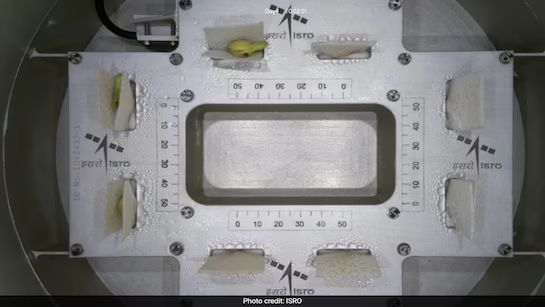

New Delhi — For the first time in Indian space history, life has sprouted aboard an ISRO spacecraft. Cowpea seeds, sent on the PS4-Orbital Experiment Module (POEM) as part of the SpaDeX mission, have germinated in the near-zero-gravity environment of space.
The experiment, conducted aboard ISRO’s Bharatiya Space Lab, demonstrated the potential of cultivating plants in space, a critical step toward the country’s long-term human spaceflight goals. Leaves are expected to grow soon, marking further progress.
In a post on X, ISRO announced, “Life sprouts in space! VSSC’s CROPS (Compact Research Module for Orbital Plant Studies) experiment onboard PSLV-C60 POEM-4 successfully sprouted cowpea seeds in 4 days. Leaves expected soon.”
A Step Towards Gaganyaan and Beyond
ISRO Chairman Dr. S. Somanath emphasized the significance of this milestone, linking it to the ambitious Gaganyaan human spaceflight program and the planned Bharatiya Antariksha Station.
“This cowpea germination test is our maiden attempt to understand how life behaves in space using indigenous experiments,” Dr. Somanath told NDTV. “It demonstrates the efficiency of our environment control and life support system (ECLSS) aboard the Indian orbital module.”
He added, “This small step for POEM could pave the way for significant advancements in life-support technologies crucial for India’s space exploration.”
Why Cowpea?
The experiment, conducted by a 15-member team from ISRO’s Vikram Sarabhai Space Centre (VSSC) in Thiruvananthapuram, focused on understanding how plants adapt to microgravity. Deputy Director T. Latha, who leads the initiative, explained that cowpea, or lobia, was chosen for its rapid germination cycle.
“Cowpea seeds can sprout and develop leaves in under a week, making them ideal for this type of study,” Latha said. The experiment revealed that seedlings lose orientation in microgravity, presenting challenges that the team is eager to explore further.
Broader Implications
Apart from growing cowpea, the POEM module carries two additional live biology experiments to study gut bacteria and spinach cell growth in space. Together, these studies aim to build a comprehensive understanding of how life adapts to extraterrestrial conditions, laying the foundation for sustainable human presence in space.
This experiment is a vital first step in ISRO’s journey to ensure astronauts can cultivate food and maintain life support systems during long-duration missions.
AI generated news post with inputs from different news feed sources on internet.

